Welcome to the Pepper Ridge North Valley's
Severe Weather Page
This is your weather warning resource page. Check this page for the latest watches and warning updates,
from The National Weather Service, Phoenix, Az.!
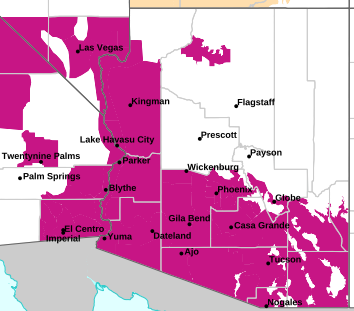
MAP OF CURRENT SOUTHWEST WATCHES, WARNINGS AND ADVISORIES
Local & Regional Weather Statements, Watches And Warnings
Weather Alerts for Yuma CountyIssued by the National Weather Service |
 FLOOD WARNING |
| YUMA COUNTY |
Areas Affected:
Maricopa, AZ - Yuma, AZ |
| Effective: Tue, 11/10 8:00am |
Updated: Tue, 11/10 9:21am |
Urgency: Expected |
| Expires: Tue, 11/17 11:00am |
Severity: Severe |
Certainty: Likely |
|
Details:
* WHAT...Flooding caused by upstream dam release is expected.

* WHERE...Maricopa County in south central Arizona...
Northeastern Yuma County in southwestern Arizona...

* WHEN...Until 1100 AM MST Tuesday Nov 17.

* IMPACTS...Flooding of rivers, creeks, streams, and other low-lying
and flood-prone locations is expected. Low-water crossings are
likely to become inundated with water and may not be passable.

* ADDITIONAL DETAILS...
- At 754 AM MST, water releases from Painted Rock Dam have started.
The amount of water released will increase during the next couple
of days, peaking at 3000 cfs.
- Flooding is expected along the Gila River.
- Some locations that will experience flooding include...
Farmlands and low-water crossings along the Gila River.
- http://www.weather.gov/safety/flood
Information:
Turn around, don't drown when encountering flooded roads. Most flood
deaths occur in vehicles.

Be aware of your surroundings and do not drive on flooded roads. |
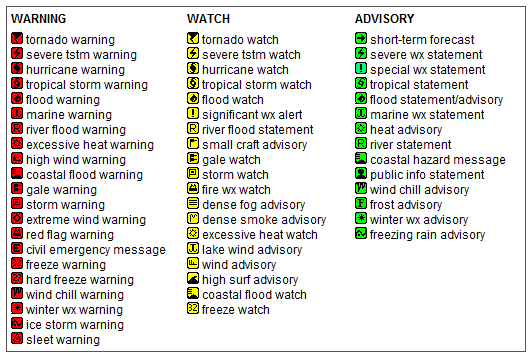
Key to Icons for Local & Regional Weather Statements, Watches And Warnings
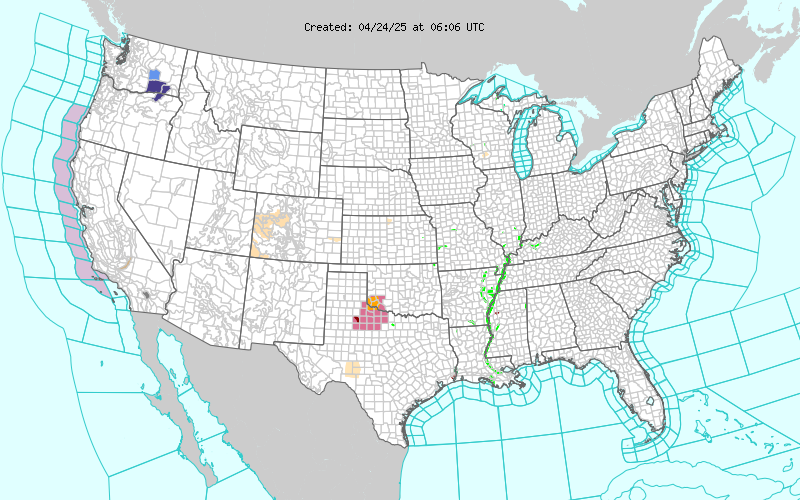
Map of the Current Watches, Warnings, and Advisories Nationwide:
|
|
Member of the:


|
North Valley Random Weather Facts |
HABOOB
The name comes from the Arabic word habb, meaning "wind." A Haboob is a giant wall of dust sometimes 3000ft tall,that travels a 40mph+, they frequently form here in Arizona from the gust front outflow boundary of summer thunderstorms. Haboobs are most frequent in Southwestern North America during the months of May through September, with the most frequent occurrence in late June, but they can occur in every month. (A picture of a classic Haboob appears on our Monsoon Page.)
Get the Facts PHP
|
|
Page layout last updated on Mar 8th, 2024
|
|
|


 New Feature